HEALTH ANXIETY · SYMPTOM CHECKING · ILLNESS FEAR

Why the search always says it's the worst

The Symptom Spiral Reset

A health-anxiety workbook to close the checking loop — without more reassurance. Here's why Google always scares you, and one move for the ten seconds before you check.

Built from 10,000+ real recovery stories · 4-min read

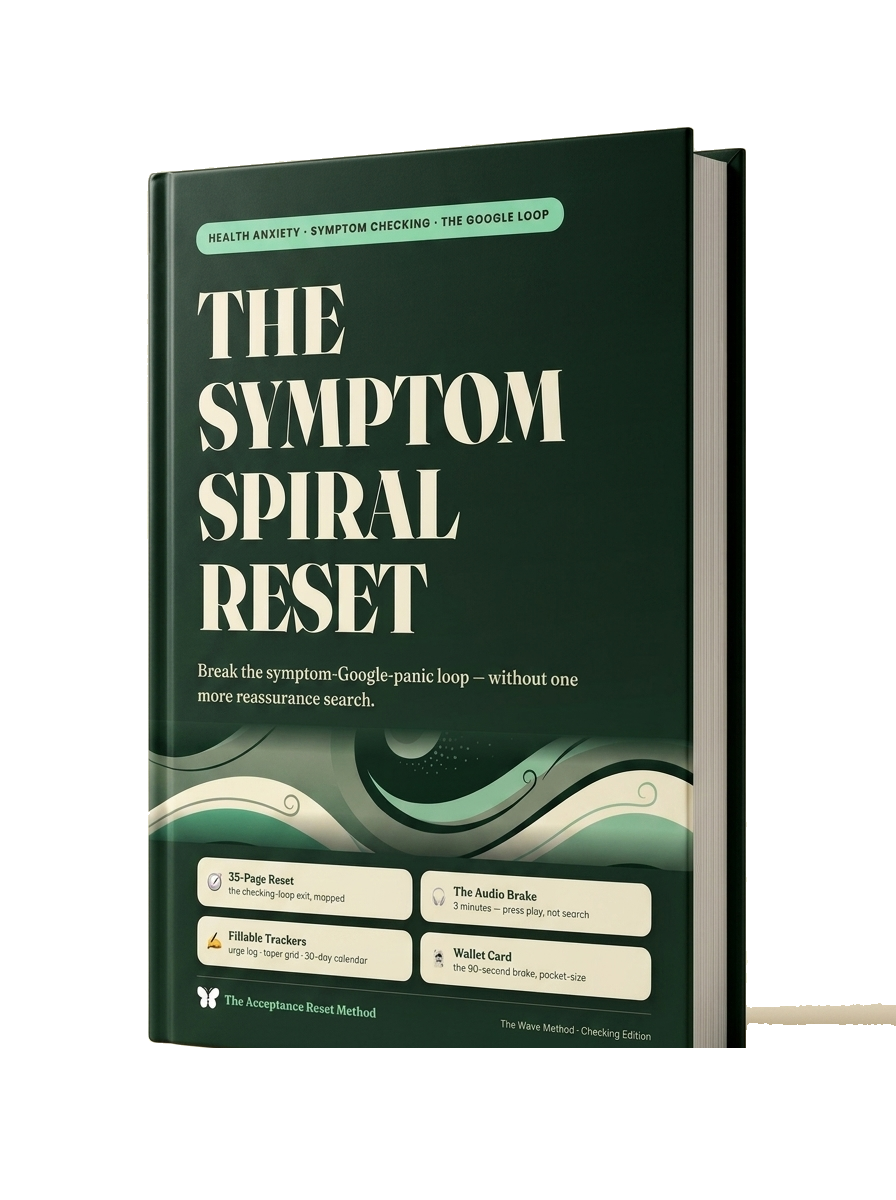
The The Symptom Spiral Reset — kit mockup
The moment

The doctor said you're fine. The fear came back by the drive home. And tonight your thumb is hovering over the search bar again.

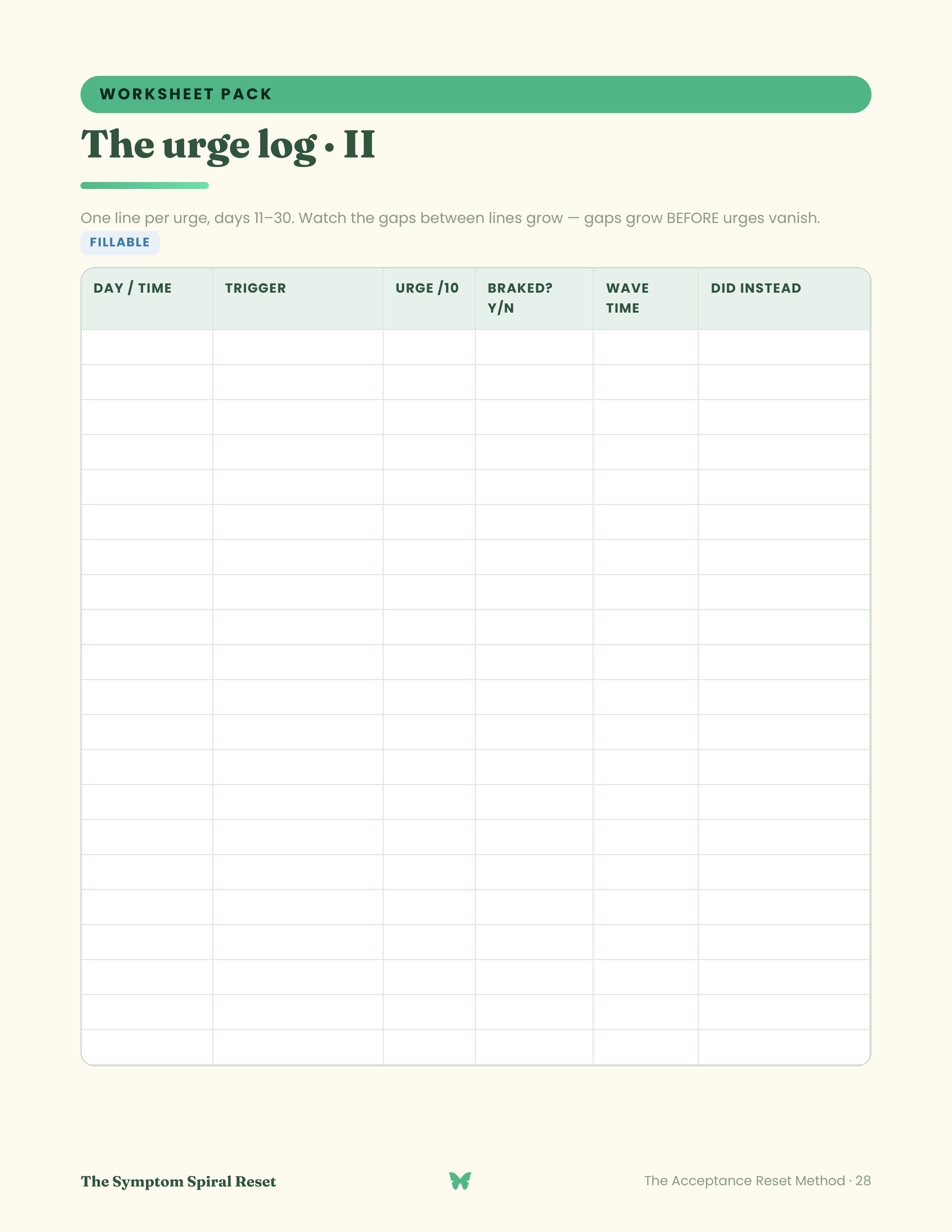
You already know how the search ends — ten minutes of scrolling, one horror story, a bigger fear than the one you started with. You've checked the pulse. Prodded the spot. Asked someone "does this look normal to you?" And every check buys about ten minutes of relief that costs you a week of sensitivity.

By now the all-clear doesn't stick. A test comes back clean and the calm lasts an afternoon, then a new sensation arrives and the whole thing starts over — a beaten fear quietly replaced by a fresh one.

Here's what nobody tells you: the loop isn't a character flaw. It's a habit with a payment system — checking pays out in relief, so your brain keeps buying — and a habit with a payment system can be dismantled.

Free · no email needed

First, the part nobody explains.

The core reframe and one move you can use — genuinely useful on its own. The kit is the full structured system.

Why the internet always says cancer — and why that's not about you.

Search engines rank what gets clicked, and the most frightening version of any symptom gets clicked the most. So when you type your symptom in, you're not "researching." You're sampling the archive of the most frightened people who ever had it. The calm, boring, it-was-nothing outcomes never made the page. The result is rigged before you press enter.

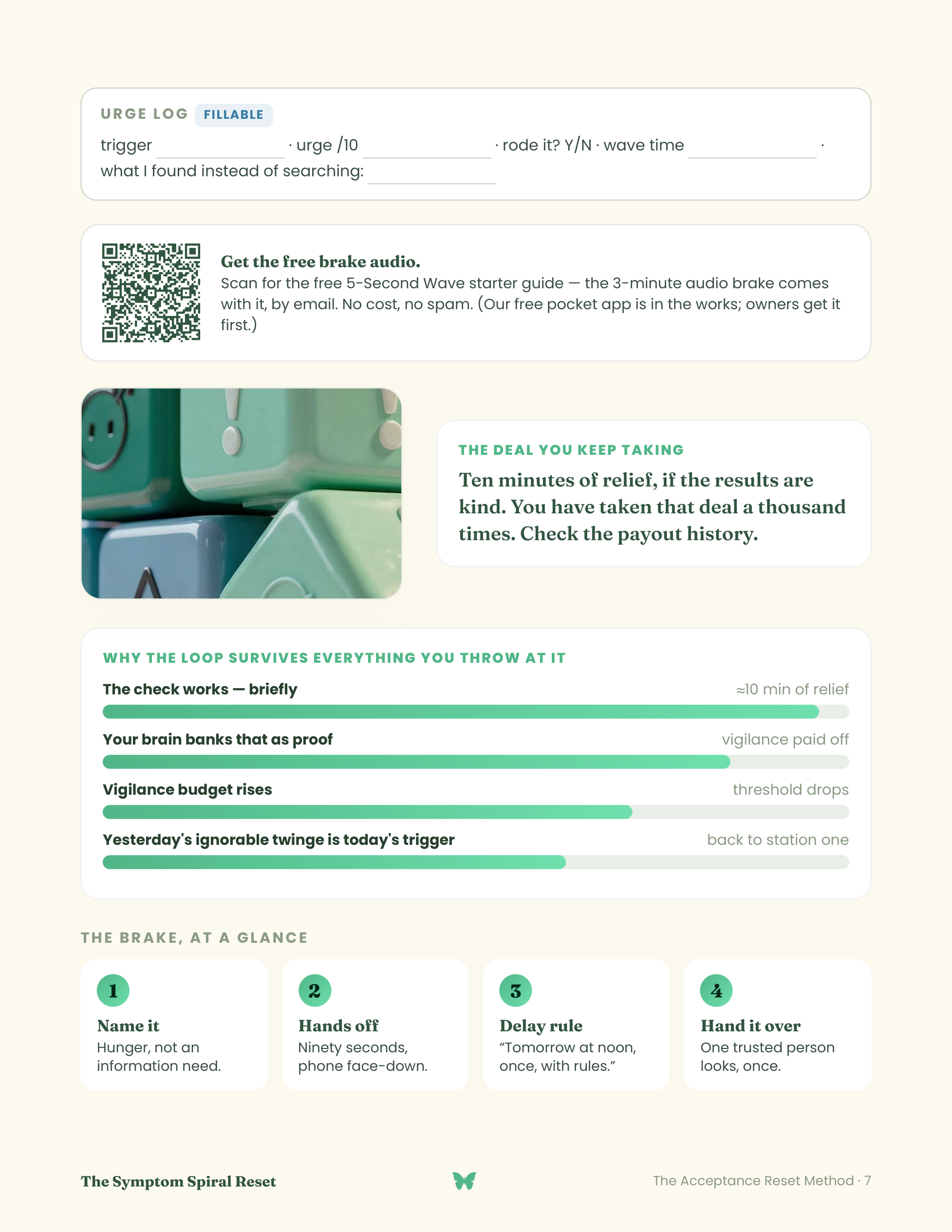
And the checking itself is the engine. Every pulse-check, every scroll, every "does this look okay?" delivers a hit of relief — which teaches your brain that the sensation was dangerous and the check is what saved you. That's why the relief never lasts and the fear always comes back hungrier. Reassurance isn't the cure for health anxiety. It's the fuel.

The way out isn't a better answer. It's letting one urge to check go un-fed, and letting your body's ordinary noise stay boring.

One move for the ten seconds before you check: name it, and let the urge crest. The next time your hand reaches for the search bar (or the pulse, or the mirror), do just this:

  1. Name the urge. "This is the checking urge — not new information." It feels like an emergency demanding an answer. It's a habit demanding its payment. Naming it breaks the spell that says you must act now.
  2. Don't feed it — let it crest. An urge is a wave, not a command: it rises, peaks in about a minute, and falls whether or not you check. Sit with your hand still and let it pass. You're not white-knuckling forever — you're declining one payment.
  3. Let the sensation be boring. Don't investigate the flutter, the twinge, the spot. Bodies hum, gurgle, ache and twitch all day; the ones you never notice are the ones you never checked. Leave this one un-poked and let it fade into the background where it belongs.
That's the move. Done a few times, it teaches your nervous system the thing reassurance never could: the sensation was safe, and the check was never what saved you.

The full kit picks up from here — the 90-Second Brake with its wallet cards, the algorithm chapter in full, the scheduled-checking taper that starves the habit without white-knuckling, sensation training, the once-rule and the real red-flag list, and the 30-day plan.

What's inside the kit

Everything you need, in one kit.

  • 36pages
  • 9worksheets
  • 1audio track
  • lifetime access
  • The 36-page designed guide — the exit from the loop, not more reassurance
  • The 90-Second Brake — the urge protocol (+ wallet cards & phone wallpapers)
  • "Why Google always says cancer" — the algorithm chapter that de-shames the whole thing
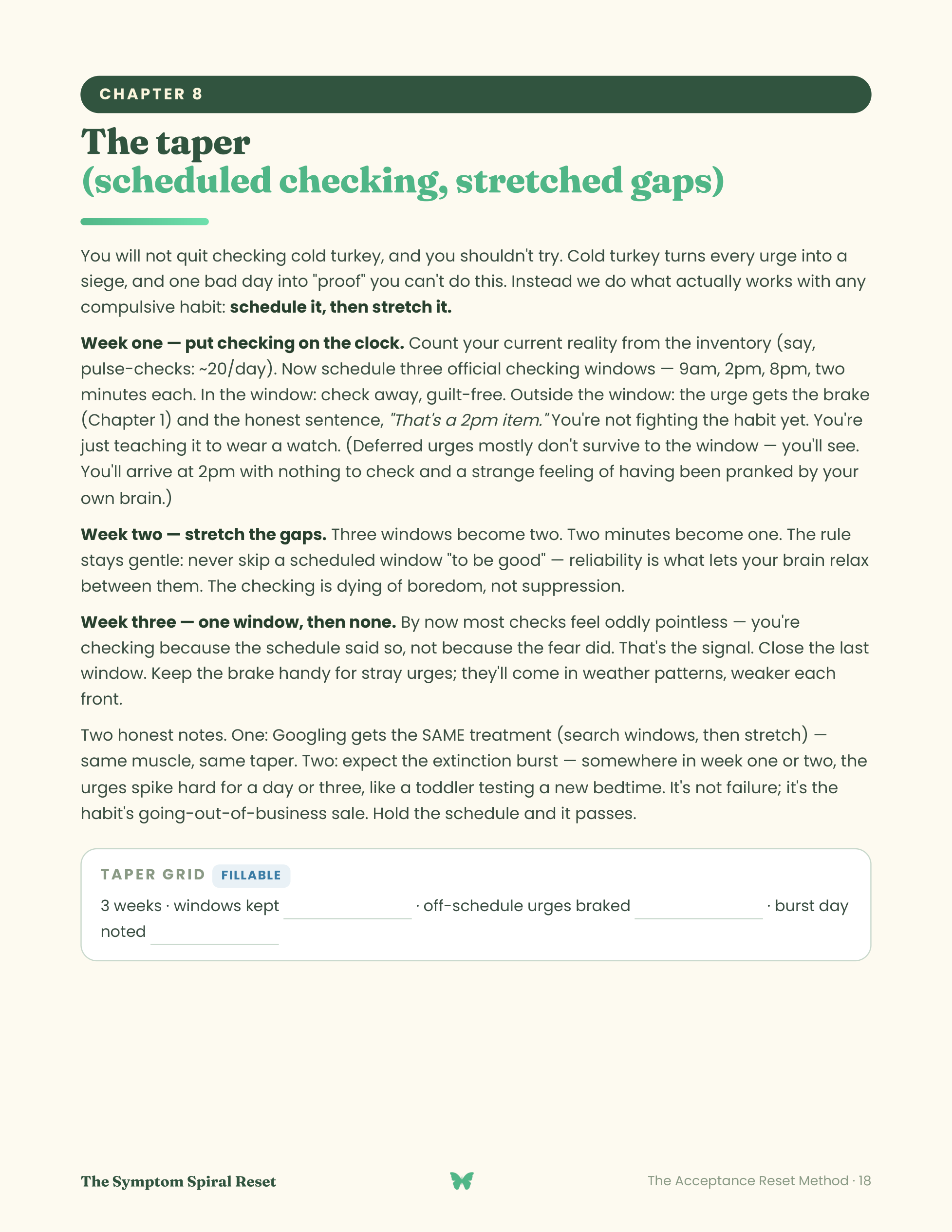
  • The full checking inventory + the 3-week scheduled-checking taper grids
  • The sensation-training ladder — make the body's noise boring again
  • The once-rule + the real red-flag list (pro-doctor, anti-re-checking)
  • The "Before You Google" 2-minute emergency audio + 30-day calendar + relapse card

🎧 Audio: “Before You Google” (2 min).

Inside The Symptom Spiral Reset — page 1 Inside The Symptom Spiral Reset — page 2 Inside The Symptom Spiral Reset — page 3
Is this you?

This is for you if…

  • You Google symptoms, check your pulse, scan your body or ask for reassurance
  • the all-clear never sticks and new fears replace old ones
  • you want an exit, not another round of reassurance
  • a doctor has already checked what's frightening you.

Maybe not, if…

  • You have a new, unusual, or unchecked symptom (get it seen first — that's the whole point of the once-rule)
  • your checking is severe, all-consuming OCD (that deserves a clinician, and the guide says so)
  • you're hoping this will tell you you're fine — it hands you an exit, not a diagnosis.

Already have The Acceptance Reset Method ($47)? This kit is the same wave method aimed at one hard moment. If you own the full method you have the principle; this gives you the specific protocol, cards and tools for this exact situation.

Questions people ask

Before you decide.

The opposite. The kit is built on the once-rule: get the frightening thing checked once, properly, and keep the answer. It's the re-checking — the tenth pulse-check, the nightly Googling after a clean result — that it helps you stop. Pro-doctor, anti-spiral.

Then it belongs to a doctor, not a workbook. The real red-flag list is on page 10, and the whole method begins after you've been medically cleared. This is for the fear that outlives the all-clear, not for a symptom you haven't had looked at.

No. It's the specific mechanism — the checking-and-relief loop and the algorithm that rigs your searches — plus the tools that starve it: the brake, the taper, the sensation work. It changes what you do in the ten seconds before a check, not just how you feel about it.

Health-anxiety checking overlaps with OCD patterns, and severe cases deserve a clinician — the guide states that plainly and points you toward help rather than pretending a workbook is enough. For the everyday Google-and-body-check spiral, this is built exactly for you.

No. The reframe and one move above are genuinely complete and free. The kit is the full structured system — the brake, the taper grids, the checking inventory, sensation training, the red-flag list and the 30-day plan — the parts that turn one un-fed urge into a closed loop.

Get The Symptom Spiral Reset.

The complete system — guide, worksheets, cards and audio. Instant download, yours forever.

$27

🛡 30-day unconditional money-back guarantee · instant PDF · free preview pages

Want the whole system? Get all the kits together in The Complete Panic Toolkit — $44.99, or the full Acceptance Reset Method — $47.

Education, not therapy

A self-guided educational program built from lived experience and published research — not medical or psychological treatment. Results vary from person to person.

One rule first

New, unusual, or unchecked symptoms — a racing heart, chest pain, anything that feels different from your normal? Get medically cleared first. This begins after a doctor has ruled physical causes out.

No cure claims

This retrains a learned alarm over time — it doesn't promise to cure anxiety or replace care from your own clinician. Any medication decisions stay between you and your doctor.

EXPLORE MORE