FREE GUIDE · SITUATIONAL ANXIETY

Panic is not everywhere. It keeps a route.

The Panic Map

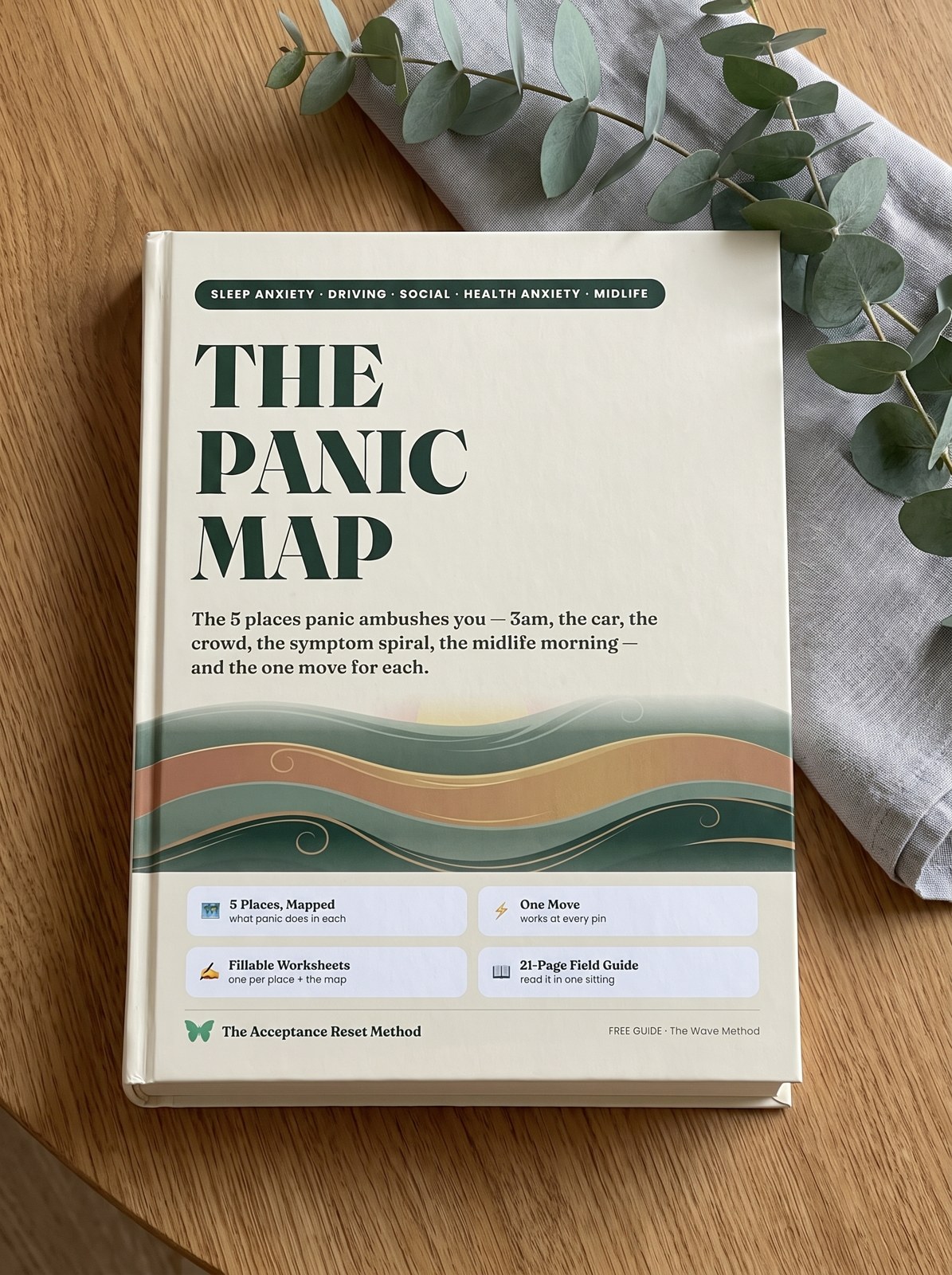
The five places panic ambushes you — the bed at 3am, the car, the crowded room, the search bar and the early morning — and the one move that works at every pin. A free 21-page field guide.

Built from 10,000+ real recovery stories · 3-min read · no card

The Panic Map — the free guide
The moment

You have probably noticed that it isn't random. It has favourite places.

The bed at 3am, when the house is quiet and there is nothing to argue with. The middle lane, somewhere between two exits. The room where you already know you'll be asked a question. The search bar at 11pm, three symptoms deep. The first ten minutes of a morning that hasn't done anything wrong yet.

And because it has favourites, you've started building your life around them — the long way round, the seat near the door, the extra hour awake because going to bed means going to that bed. The map keeps shrinking, and every road you take off it is a road panic gets to keep.

Here is the sentence this guide starts from, the one every sufferer knows from the inside: the fear of the fear is stronger than the thing itself. You are not avoiding the motorway. You are avoiding what your body does on the motorway.
The move · free, right here

First, the part nobody explains.

The reframe and the move itself — on this page, in full. The guide is the same thing designed to be usable when it's actually happening.

Five places, one mechanism.

It looks like five different problems. It feels like five different problems — night panic and driving panic and health anxiety don't seem like relatives. But they run on identical machinery: a false alarm, a place your brain has tagged as the scene of a previous alarm, and a set of escapes that keep proving the tag was correct.

That's why fixing them one at a time never finishes. You get the motorway back and lose the supermarket. You beat the 3am wake and start checking your pulse instead. Whack-a-mole is what treating the place instead of the mechanism looks like.

The move is the same at every pin, because the alarm is the same at every pin. What changes is the local disguise — what panic says in the car is not what it says in the bed, and knowing its script for your particular place is most of the fight.

The move, and its local version. The core is three steps, and it does not change:

  1. Call it. "False alarm. Adrenaline, not danger." Name it and you move from inside the wave to beside it.
  2. Retire. "I'm done managing this one." Stop running the technique. Stop checking whether it's working. The checking is the fuel.
  3. Give it permission. "Go ahead." Let it peak without a response. That is the exposure, and it is the only thing that reteaches the alarm.

Now the part that makes it work in your place. Each of the five gets a local translation — because "let it peak" means something different at 70mph than it does under a duvet:

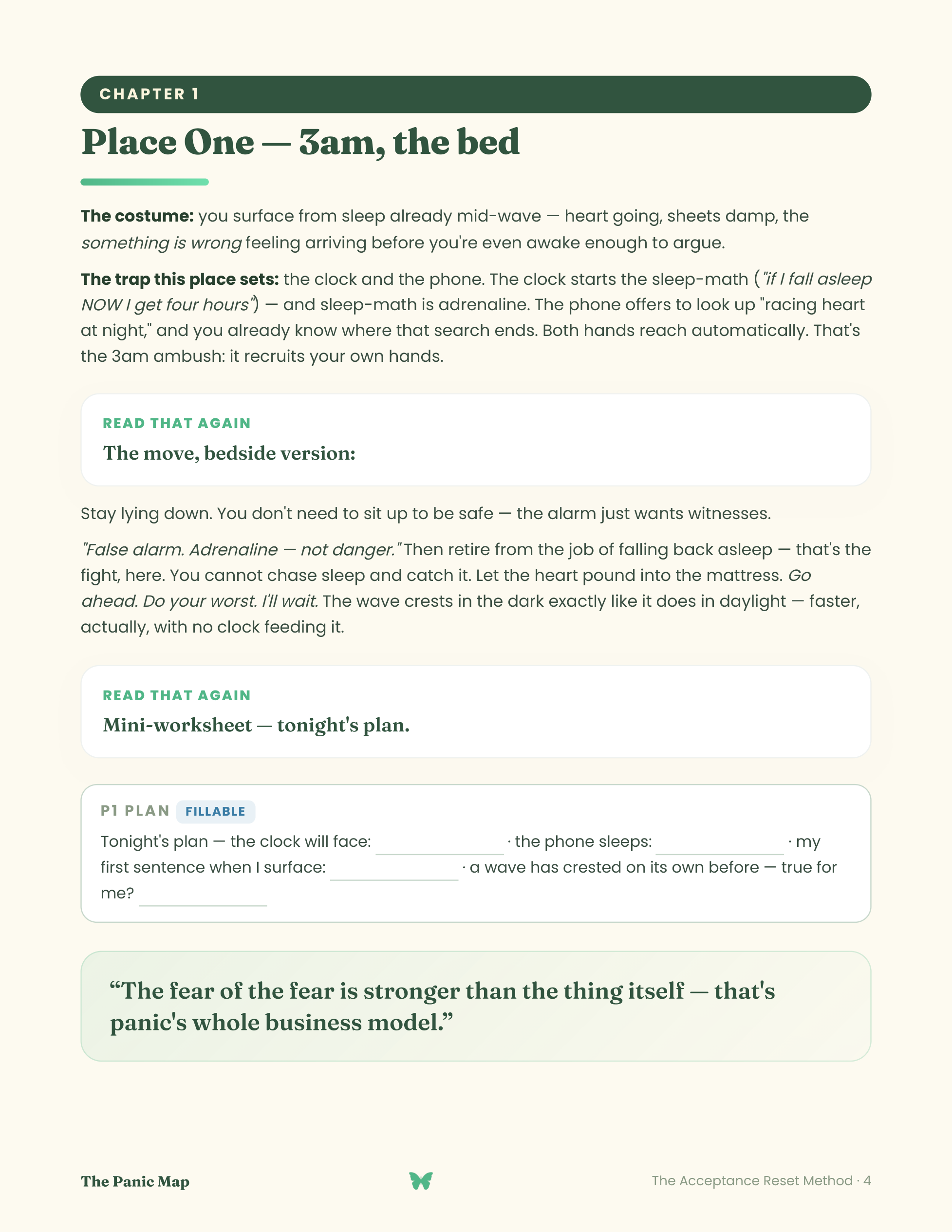
- The bed at 3am — the move is done lying still, and the thing you're declining to do is the sleep-maths. - The car — you keep driving. Hands stay on the wheel; the move happens while the road continues. - The room — you stay in the conversation. The escape you're refusing is the exit, the phone, the bathroom. - The search bar — the move is applied to the urge to check, not to the symptom. - The morning — you let the surge arrive before you've decided what it means about the day ahead.

The guide takes each one properly, with the trap it sets and a fillable page to work it through. Start with the pin that costs you the most.

What's inside the free guide

The whole thing. No paid version.

  • 21pages
  • 134fillable fields
  • Freeno card needed
  • yours to keep
  • The five places, mapped — what panic does in each and the trap it sets there
  • The one move, with its local version for every pin
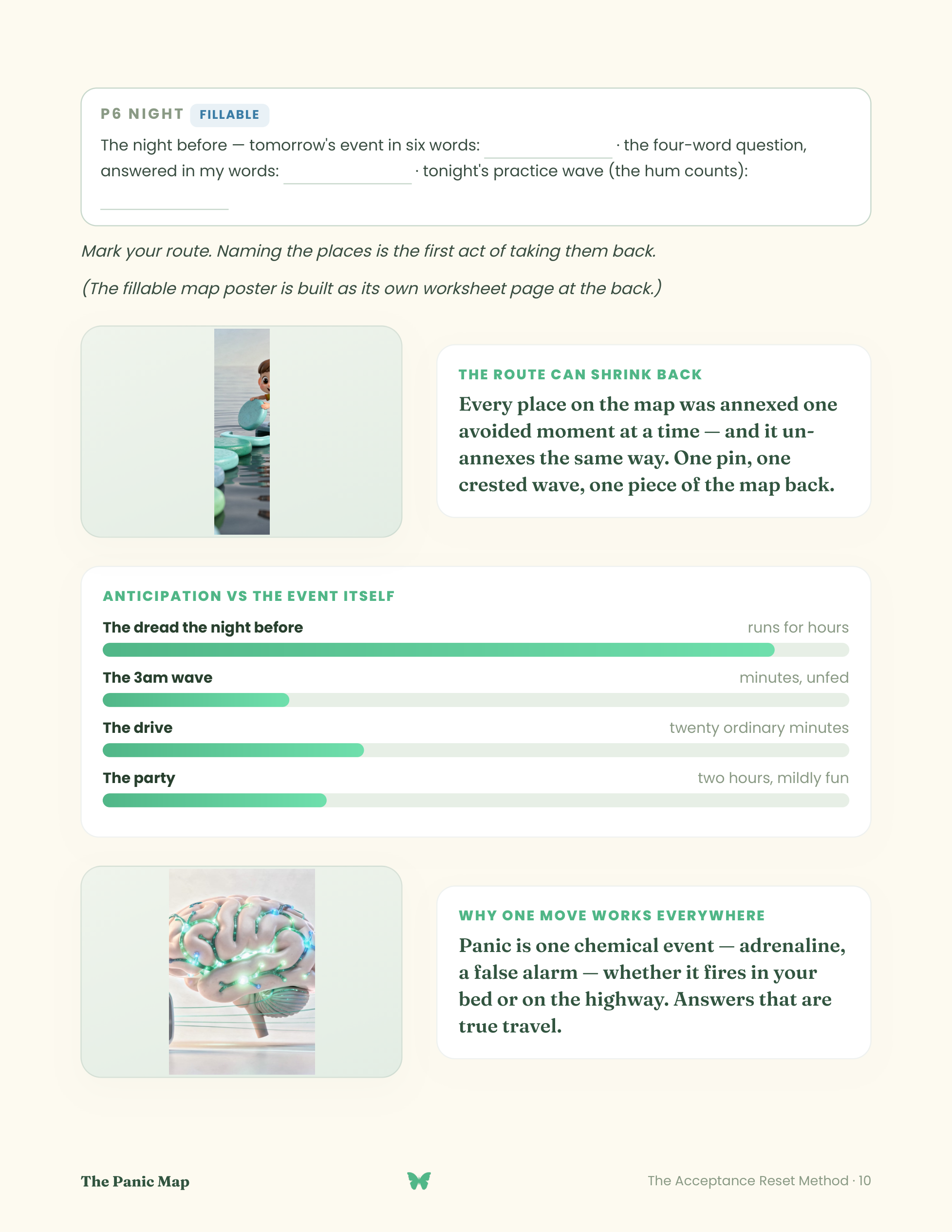
  • The night-before chapter, for the dread that arrives before the place does
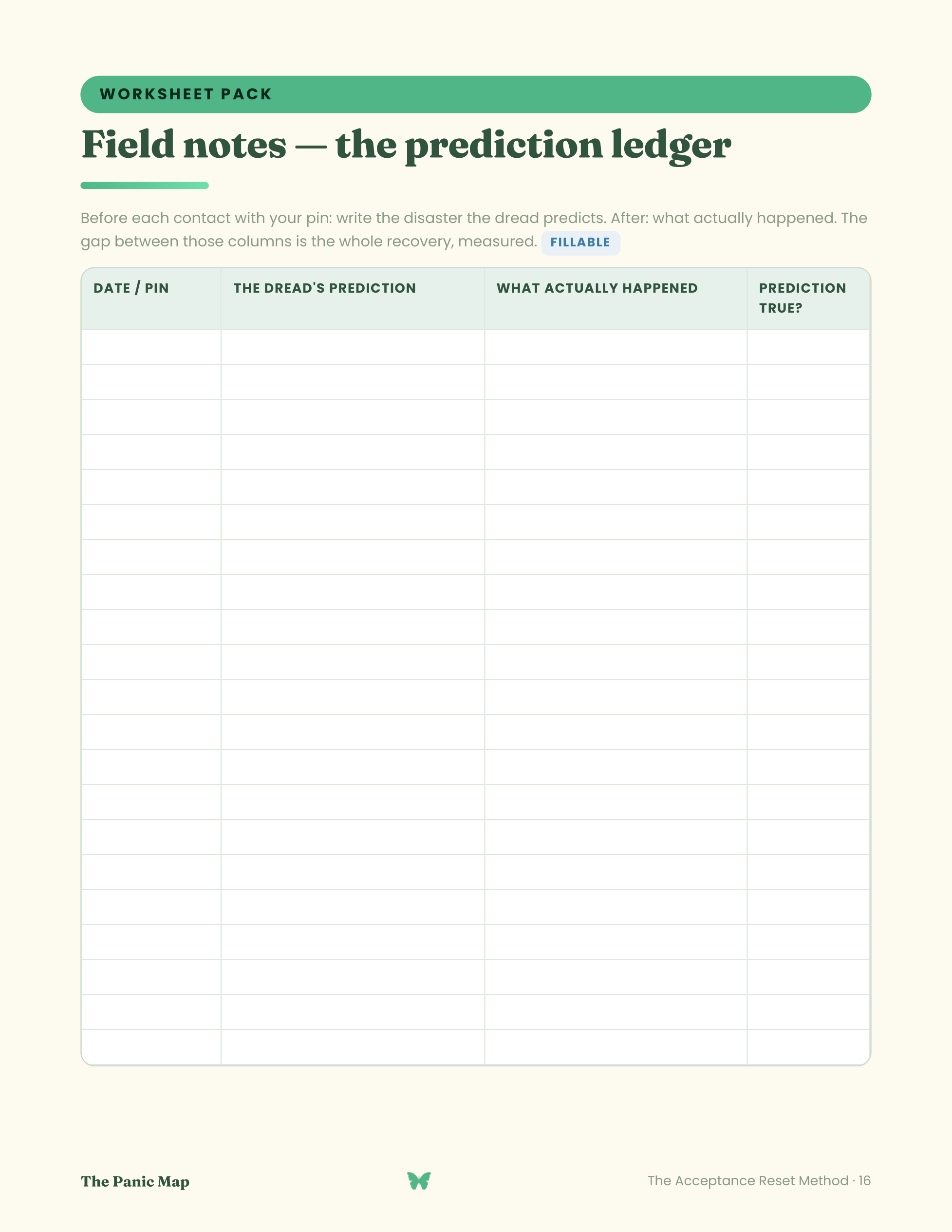
  • Six fillable mini-worksheets — one per place, plus the week plan
  • The cut-out condensed map card for your wallet
  • The one-pin week: how to take back a single place without fighting on five fronts
Inside The Panic Map — page 1 Inside The Panic Map — page 2 Inside The Panic Map — page 3
Is this you?

This is for you if…

  • Panic keeps finding you in the same specific situations
  • you've started planning around places rather than through them
  • you've fixed one and watched another appear
  • you want the mechanism underneath all five, not five separate tip lists.

It's not for you if…

  • You want a medication or supplement protocol — this is behavioural
  • your symptoms are new or unchecked (get medically cleared first, see below)
  • you're after a single technique and no reading; this maps a pattern, which takes a few pages.
FREE — INSTANT DOWNLOAD

Where should I send it?

Your Panic Map field guide — all five places, the one move with its local version for each, six fillable worksheets and the cut-out map card. Straight to your inbox, downloadable the second you hit the button. No card, no catch.

One email to deliver it, then a short series you can leave any time. No spam, ever. Educational content — not medical advice.

Questions

Before you give me your email.

Yes — all 21 pages, the five chapters, the worksheets and the map card. Nothing is held back for a paid version. It downloads instantly on the next page and you'll get an email copy too.

Very likely, because the five are the most common presentations, not the whole list. The mechanism chapter and the three-step move are place-agnostic — the local versions are worked examples showing you how to translate it. Readers apply it to flying, dentists, lifts and presentations using the same pattern.

No. It's education built from lived experience and published research, not treatment. If symptoms are new, unusual or you haven't had them looked at — chest pain especially — get medically cleared first. The guide says this on its own second page, before it asks you to do anything.

One. Deliberately one. The guide's week plan is built around a single pin on purpose — taking back one place teaches your alarm something that generalises, whereas fighting on five fronts at once is how people end up concluding it doesn't work for them. Pick the one that's costing you the most and leave the other four alone.

Education, not therapy

A self-guided educational program built from lived experience and published research — not medical or psychological treatment. Results vary from person to person.

One rule first

New, unusual, or unchecked symptoms — a racing heart, chest pain, anything that feels different from your normal? Get medically cleared first. This begins after a doctor has ruled physical causes out.

No cure claims

This retrains a learned alarm over time — it doesn't promise to cure anxiety or replace care from your own clinician. Any medication decisions stay between you and your doctor.

If you're in crisis

This guide is not emergency support. In the US call or text 988; in the UK call 116 123. If you are in immediate danger, call your local emergency number.

MORE FREE MOVES