FREE GUIDE · PANIC ATTACK RELIEF

What to do when breathing stops working

Panic First Aid

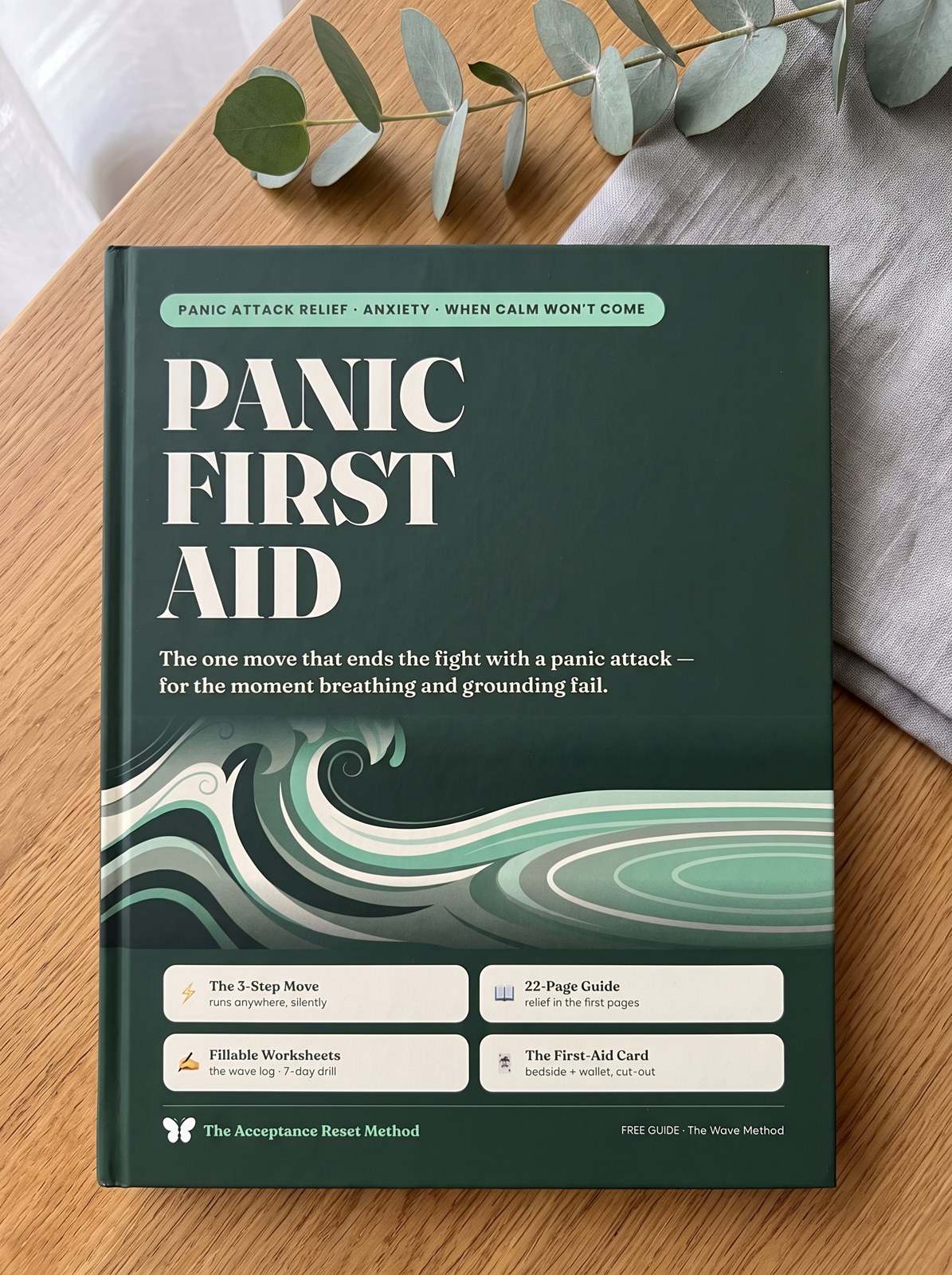
The one move for the moment a panic attack is already happening — when the breathing exercise isn't landing and the grounding list has run out. A free 22-page guide with the first-aid card and a 7-day drill.

Built from 10,000+ real recovery stories · 3-min read · no card

Panic First Aid — the free guide
The moment

It's already started. The floor has gone slightly unreal, your chest is tight in a way that feels medical, and some calm voice in your head is saying breathe in for four while the rest of you is quietly certain that this time is different.

So you run the list. Four-seven-eight. Five things you can see, four you can touch. Cold water on the wrists. And for a second it almost works — and then it doesn't, and now there's a new problem on top of the old one: the thing that's supposed to fix this isn't fixing it.

That's the moment this guide is for. Not the anxious afternoon. Not the general worry. The ninety seconds where the technique fails and you're left holding it.

Here's the part nobody says out loud: the techniques didn't fail because you did them wrong. They failed because every one of them is a way of fighting — and fighting is the one thing that tells your alarm it was right to fire.

The move · free, right here

First, the part nobody explains.

The reframe and the move itself — on this page, in full. The guide is the same thing designed to be usable when it's actually happening.

Why the effort itself is feeding it.

A panic attack runs on adrenaline, and adrenaline has a hard ceiling. Your body physically cannot hold the alarm at full volume — it surges, it peaks, and it falls. There is no version of a wave that doesn't break. That part is not willpower. It's chemistry, and it's already on your side.

So why does it feel endless? Because of what you do at the peak. Every escape — the breathing ritual, leaving the room, the glass of water, checking your pulse — lands in your brain as the same lesson: that was real danger, and we got out just in time. The alarm files it, and fires sooner next time. That's the loop. Not weakness. Training.

Which means the move that ends a panic attack cannot be another way to make it stop. It has to be the opposite: the one response that gives your alarm nothing to learn from.

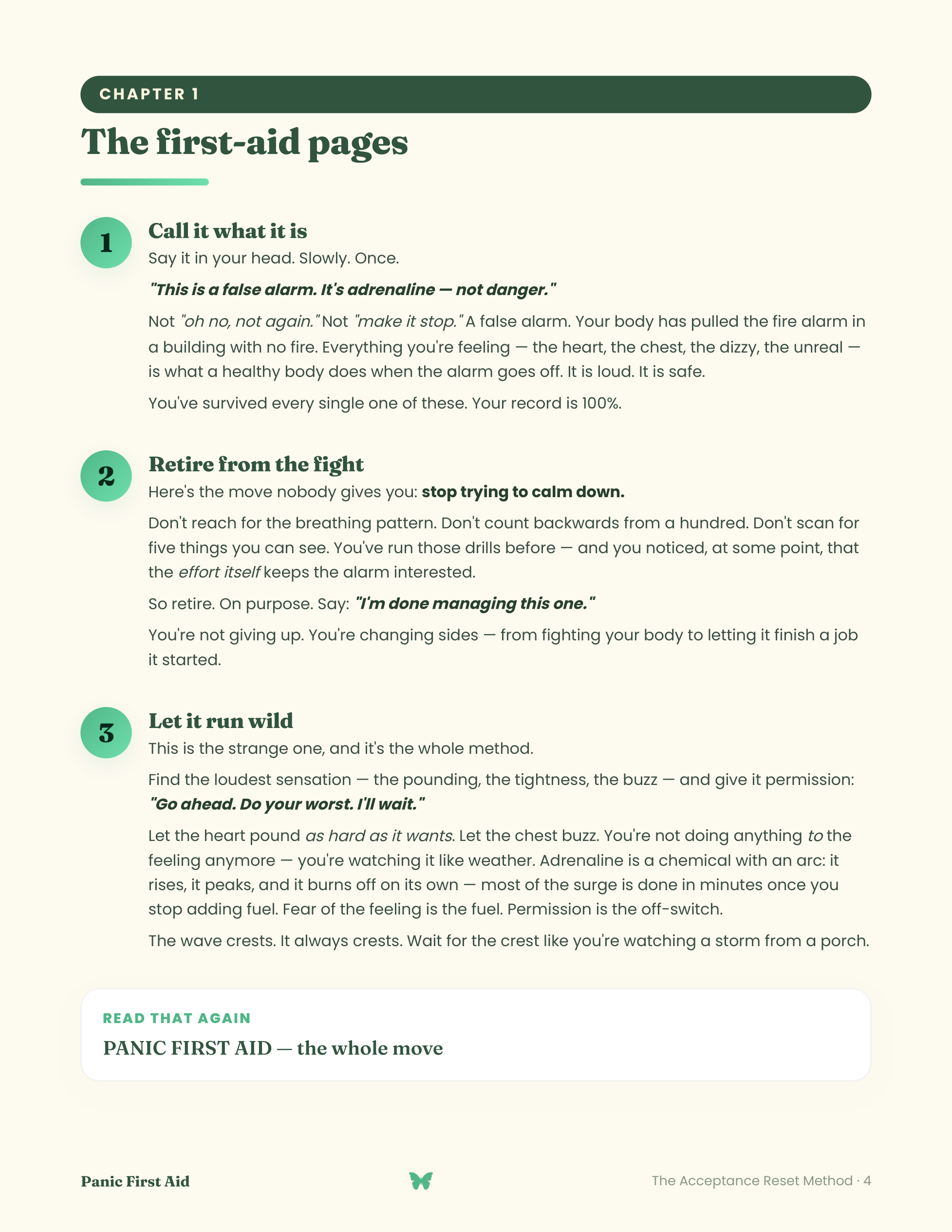
The move, in three lines. You don't have to memorise it — it's on an oversized page in the guide, readable mid-attack. When the next one starts, and the breathing isn't landing:

  1. Call it. Out loud if you can, silently if you can't: "False alarm. This is adrenaline, not danger." You are not talking yourself down — you're labelling it. That label is the whole difference between being inside the panic and standing beside it.
  2. Retire. "I'm done managing this one." Put the toolkit down. No counting, no technique, no checking whether it's working. This is the step that feels impossible and is doing all the work — you are declining to give the alarm its evidence.
  3. Give it permission. "Go ahead." Let it peak. Let your heart do what it's doing. You are not waiting for it to stop; you're demonstrating, in your own body, that it needs no response from you.
That's it. It is deliberately harder to believe than to do.

The first time you get through one this way you will have taught your nervous system something ten years of breathing exercises could not: the wave finishes on its own, and you do not have to do anything about it.

What's inside the free guide

The whole thing. No paid version.

  • 22pages
  • 122fillable fields
  • Freeno card needed
  • yours to keep
  • The 3-step move on three oversized pages — designed to be readable while it's happening
  • The cut-out first-aid card for your wallet and your bedside table
  • Why breathing and grounding keep almost-working, then failing
  • What is actually happening in your body during an attack, honestly and without minimising
  • The 7-day drill that makes the move automatic before you need it
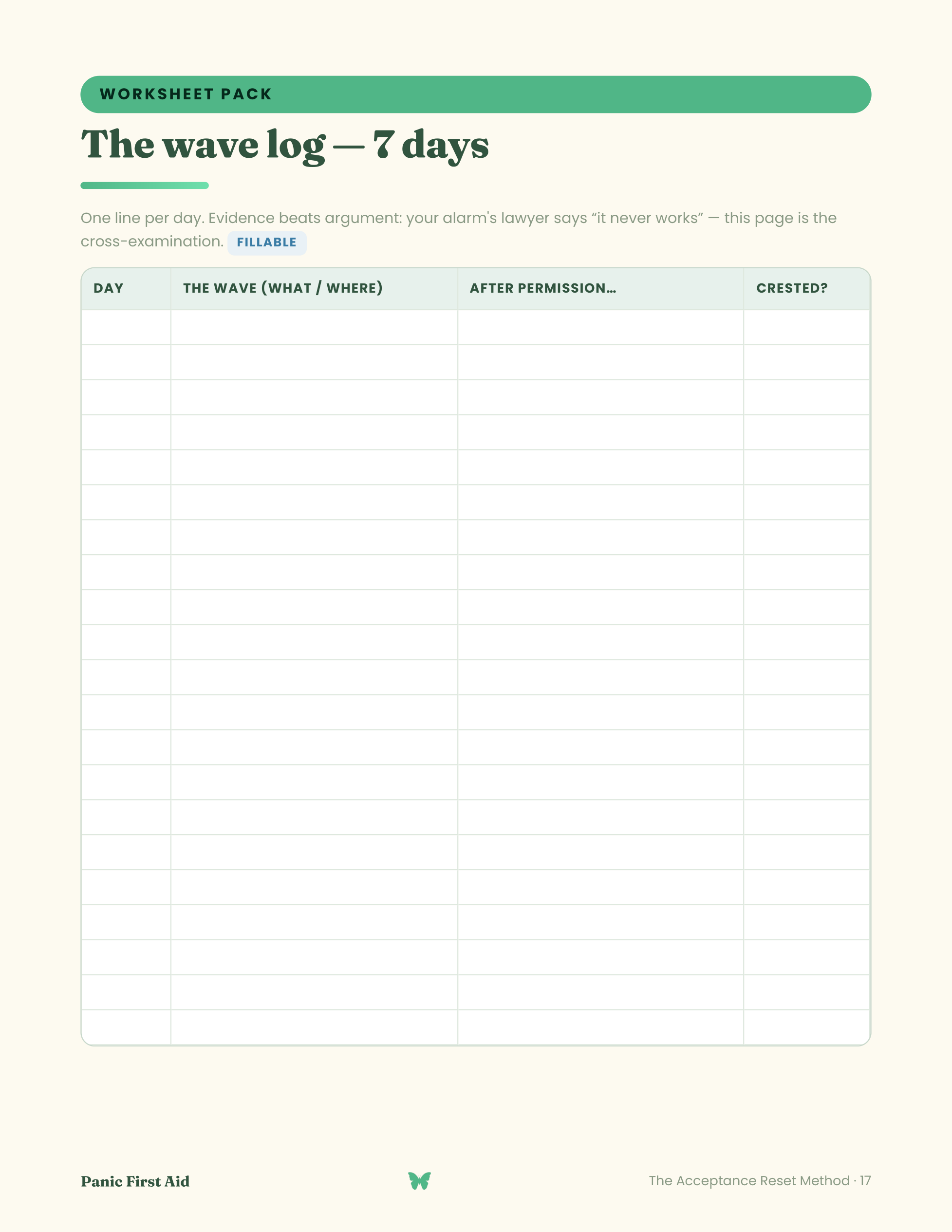
  • The wave log and the retirement letter — fillable on your phone or printable
Inside Panic First Aid — page 1 Inside Panic First Aid — page 2 Inside Panic First Aid — page 3
Is this you?

This is for you if…

  • You get full panic attacks, not just background anxiety
  • you've been handed breathing and grounding and they stop working exactly when you need them
  • you want something usable during an attack, not a theory to read afterwards
  • you'd rather understand the mechanism than collect more tips.

It's not for you if…

  • You're looking for a medication or supplement protocol — this is behavioural
  • you've never had these symptoms medically checked and they're new to you (see the rule below)
  • you want the panic gone by tonight; this retrains an alarm over days, honestly, not instantly.
FREE — INSTANT DOWNLOAD

Where should I send it?

Your Panic First Aid guide — the 3-step move, the cut-out first-aid card and the 7-day drill, straight to your inbox and downloadable the second you hit the button. No card, no price box, no catch.

One email to deliver it, then a short series you can leave any time. No spam, ever. Educational content — not medical advice.

Questions

Before you give me your email.

It's the complete guide — 22 pages, the full move, the card and the drill, yours to keep. There's no cut-off chapter and no upgrade required to use it. You'll get an email with it and it downloads instantly on the next page.

No. It's education built from lived experience and published research, not treatment. New, unusual or unchecked symptoms — chest pain, a racing heart you haven't had looked at, anything that feels different from your normal — get medically cleared first. That's the guide's own first rule, on page 2, before the move on page 7.

Because everything on that list is a calming tool, and a calming tool's job is to make the wave smaller right now. Every time one works, your alarm learns the danger was real. This runs the opposite direction — it lets the wave finish, which is the only outcome that teaches the alarm there was nothing to flee. It isn't technique number forty-seven. It's the reason the other forty-six didn't hold.

Almost nobody can, the first time. "I'm done managing this one" is the hardest sentence in the guide because it asks you to drop the only thing that has ever felt like control. The 7-day drill exists precisely for this — you practise the move on small waves, when nothing is at stake, so it's available on a big one.

Education, not therapy

A self-guided educational program built from lived experience and published research — not medical or psychological treatment. Results vary from person to person.

One rule first

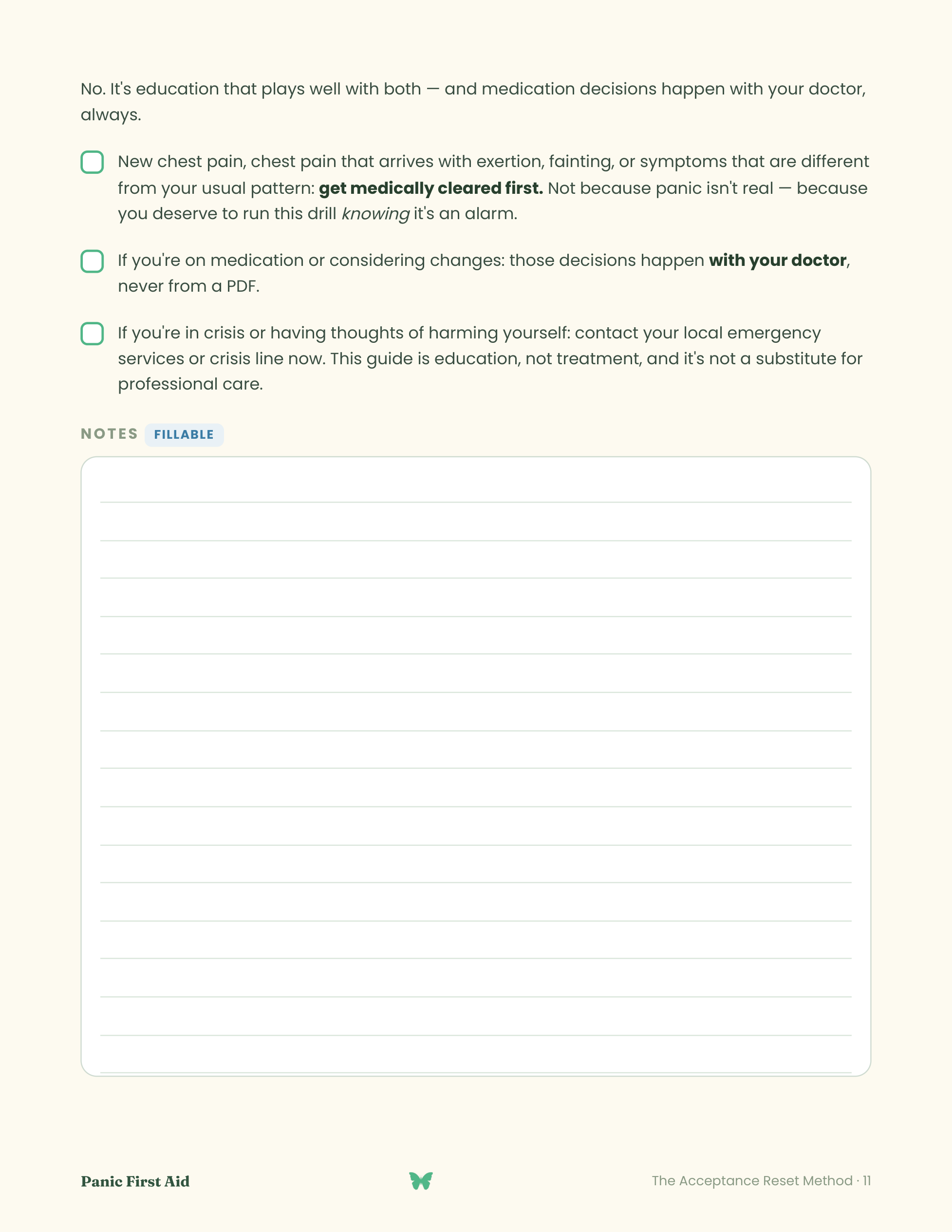
New, unusual, or unchecked symptoms — a racing heart, chest pain, anything that feels different from your normal? Get medically cleared first. This begins after a doctor has ruled physical causes out.

No cure claims

This retrains a learned alarm over time — it doesn't promise to cure anxiety or replace care from your own clinician. Any medication decisions stay between you and your doctor.

If you're in crisis

This guide is not emergency support. In the US call or text 988; in the UK call 116 123. If you are in immediate danger, call your local emergency number.

MORE FREE MOVES