A sleep-anxiety kit for night panic and racing thoughts, without trying to calm down. Start with why it happens, and one thing to try the next time you wake.
★ Built from 10,000+ real recovery stories · 4-min read
It's 3:07am. You're wide awake. Heart pounding, mind sprinting, already doing the math on how little sleep you'll get if you fall asleep right now. Again.
You've done everything they told you to. The sleep-hygiene checklist. The teas, the magnesium, the app with the rain sounds. Breathing exercises performed through gritted teeth. And still the jolt arrives. A dead-sleep wake-up, heart already going, thoughts replaying a conversation from three years ago, a body that's exhausted while the brain runs a marathon.
By now the bed itself has started to feel like the enemy. You dread it before it's even dark. You lie there scared to fall back asleep in case it happens again, and by now that fear has become worse than the not sleeping.
Almost no one tells you this: you don't have insomnia. You have a false alarm with unusually good timing. Every technique you've tried has quietly failed for the same reason. They are all ways of fighting the wave, and fighting is exactly what keeps it going.
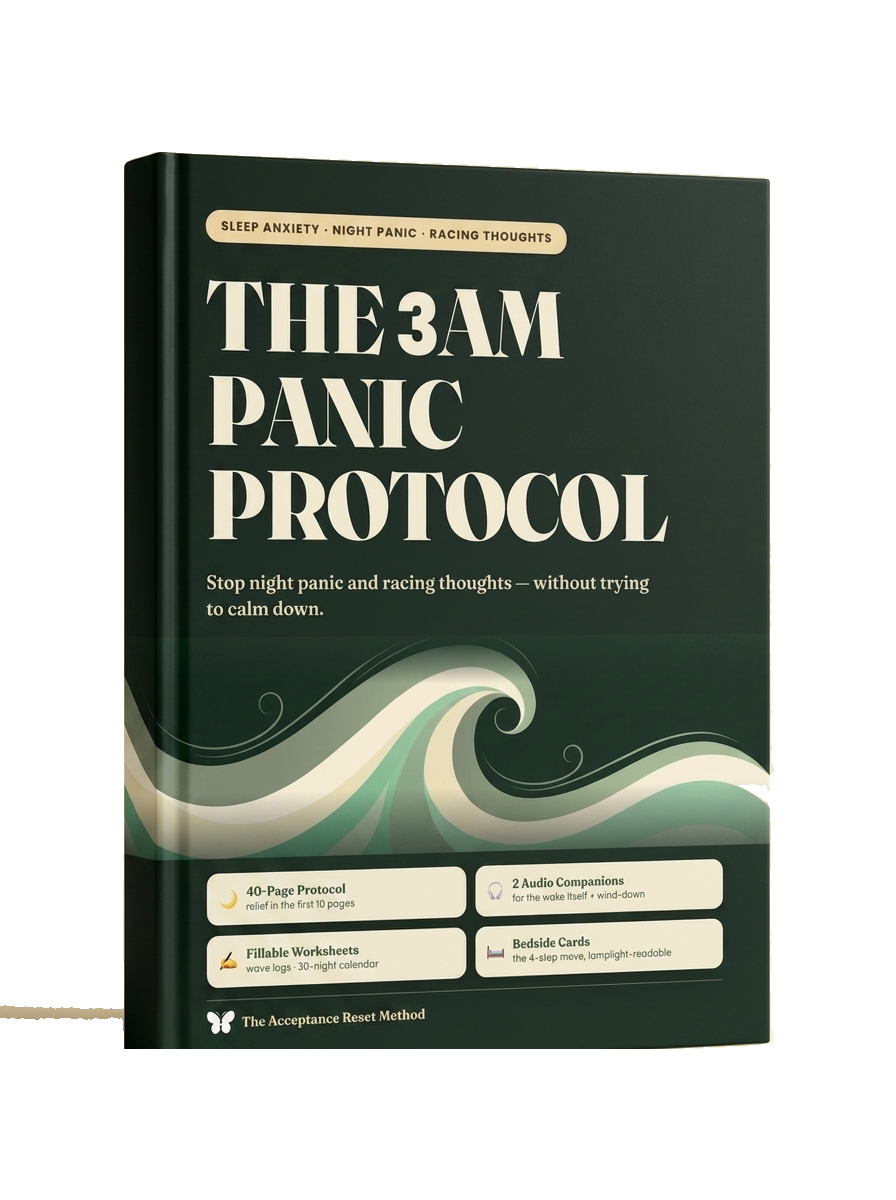
The core reframe and one move you can use — genuinely useful on its own. The kit is the full structured system.
Why 3am specifically. It's a schedule glitch, not a breakdown.
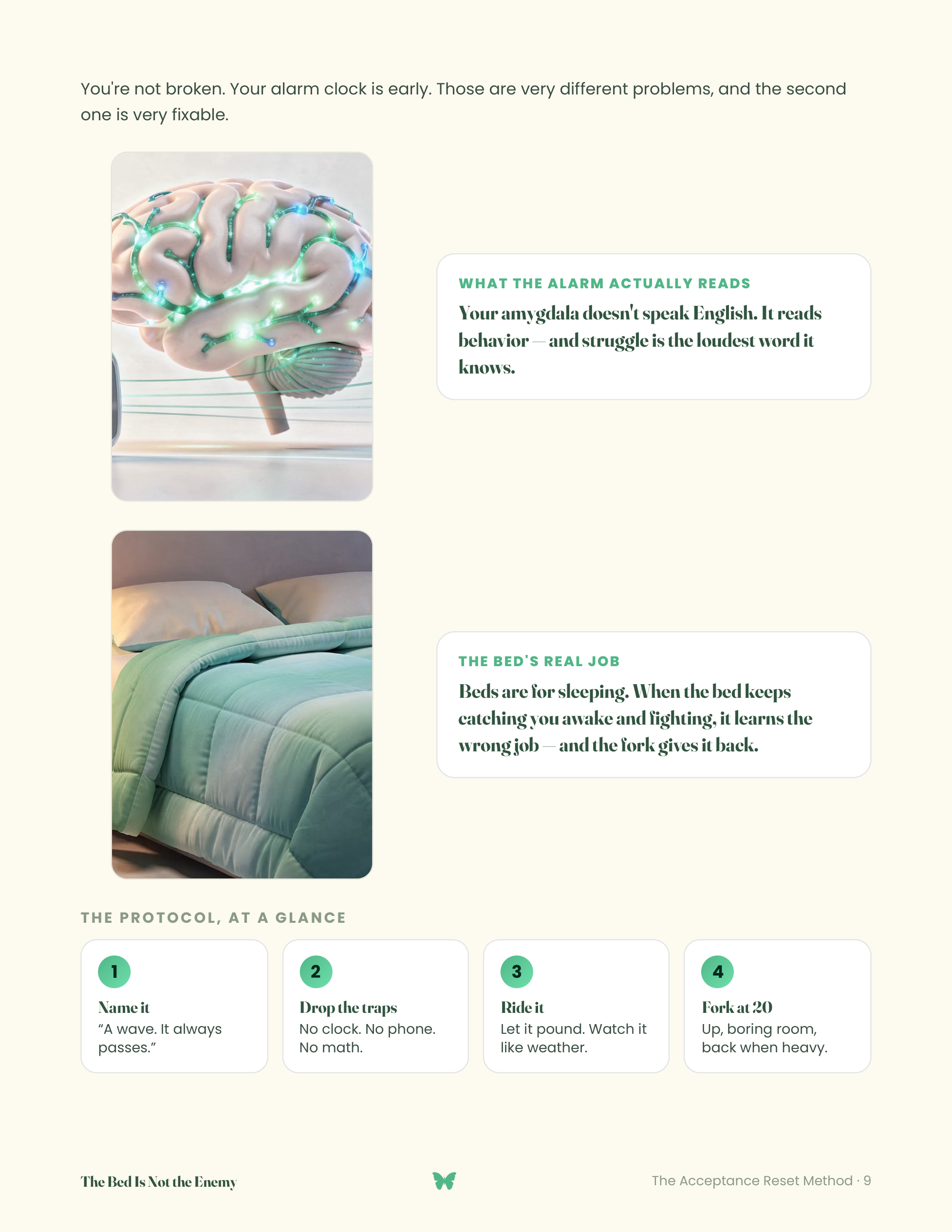
Your cortisol (the body's built-in "get ready" signal) runs on a clock. It's supposed to rise toward morning to wake you gently. In a stretched-out nervous system that pulse can arrive early, around 2 or 3am, landing while you're in light sleep. The result is a body that flips to full alert for no reason you can name.
That first jolt isn't the problem. It's normal biology arriving at an inconvenient time. The panic is the story your mind tells about the jolt. Something's wrong. I'll never sleep. Tomorrow's ruined. That story is what turns a passing surge into a two-hour ordeal.
This is why "just calm down" makes it worse. To your alarm system, effortfully trying to control the moment reads as more danger. Proof that this really is an emergency. So the harder you push the wave down, the louder it argues back. The way out isn't a better fight. It's to stop fighting.
One move you can use at 3am tonight: name it, and drop the math. You don't need to memorise anything. When you next wake with the surge, do just this:
That's the whole move. Practised a few nights, it teaches your nervous system the one thing it never learned: the 3am wave is safe to ignore, and it passes on its own.
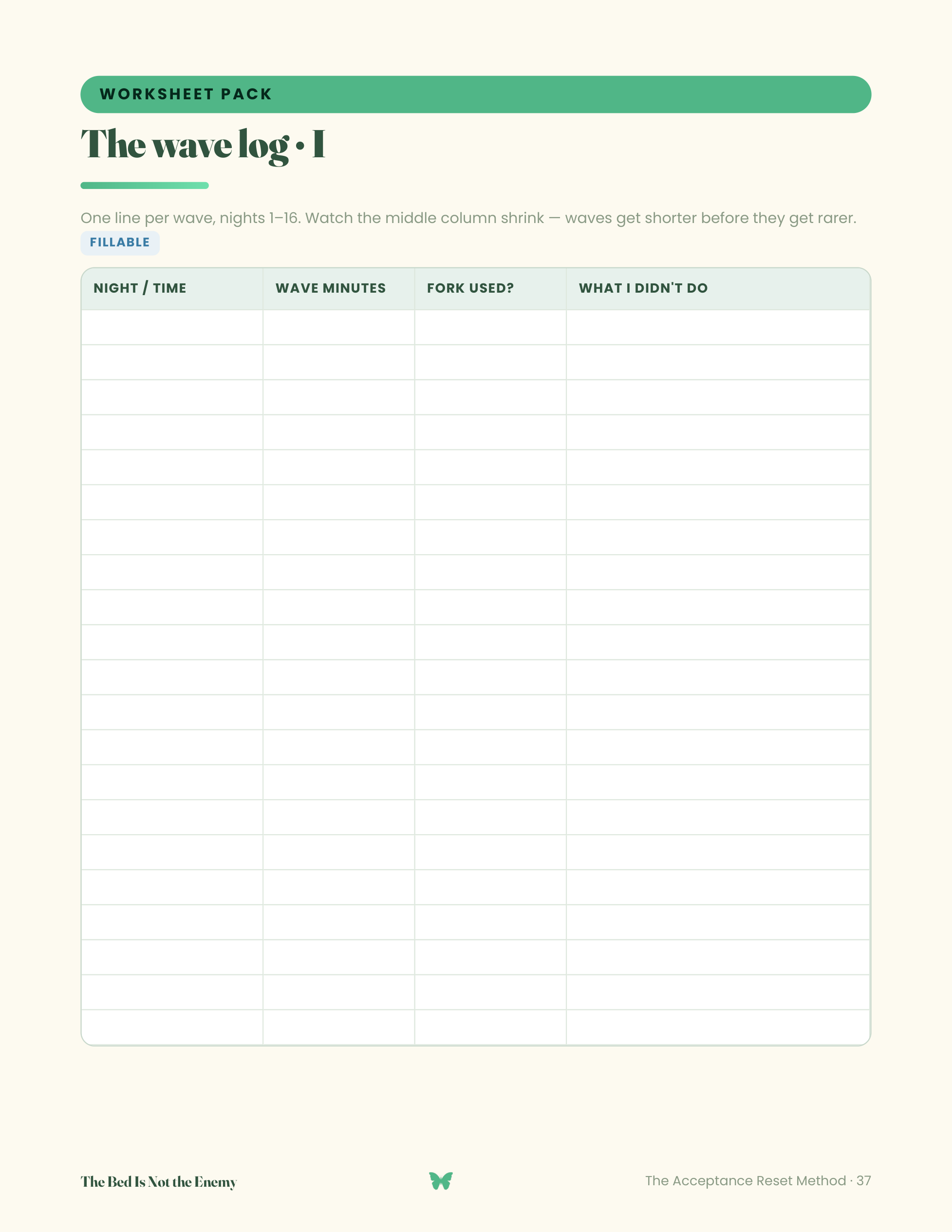
The full kit picks up exactly where this leaves off — the complete 4-step bedside protocol, the stay-in-bed-or-get-up decision, the week that retrains your bed from a battleground back into a place of rest, the daytime habits that quietly buy you quieter nights, and the 30-night plan with the progress line nobody mentions: the waves get shorter before they get rarer.
🎧 Audio: “The 3AM Rescue” (4 min) · “Wind-Down Without Trying” (9 min).

Already have The Acceptance Reset Method ($47)? This kit is the same wave method aimed at one hard moment. If you own the full method you have the principle; this gives you the specific protocol, cards and tools for this exact situation.
No. It's education built from lived experience and published research, not treatment. New, unusual, or unchecked symptoms — a racing heart you haven't had looked at, chest pain, anything that feels different from your normal — get seen by a doctor first. That's the guide's own first rule, not an afterthought.
The move above is usable from the first wave — most people feel the difference of not fighting right away. The deeper retraining compounds over the 30-night plan; the honest timeline inside shows waves getting shorter before they get less frequent, so you can see it working instead of guessing.
Because those treat it as a sleep problem. This treats the 3am wake as a false alarm and retrains the alarm — the same extinction principle clinical exposure work is built on. It's not a better version of the sleep-hygiene list; it's the opposite approach.
No — the guide stands on its own. But at 3am a voice beats a page, so the kit includes two method-based tracks (a short one for the wake itself and a longer wind-down) with no "just relax" language in either.
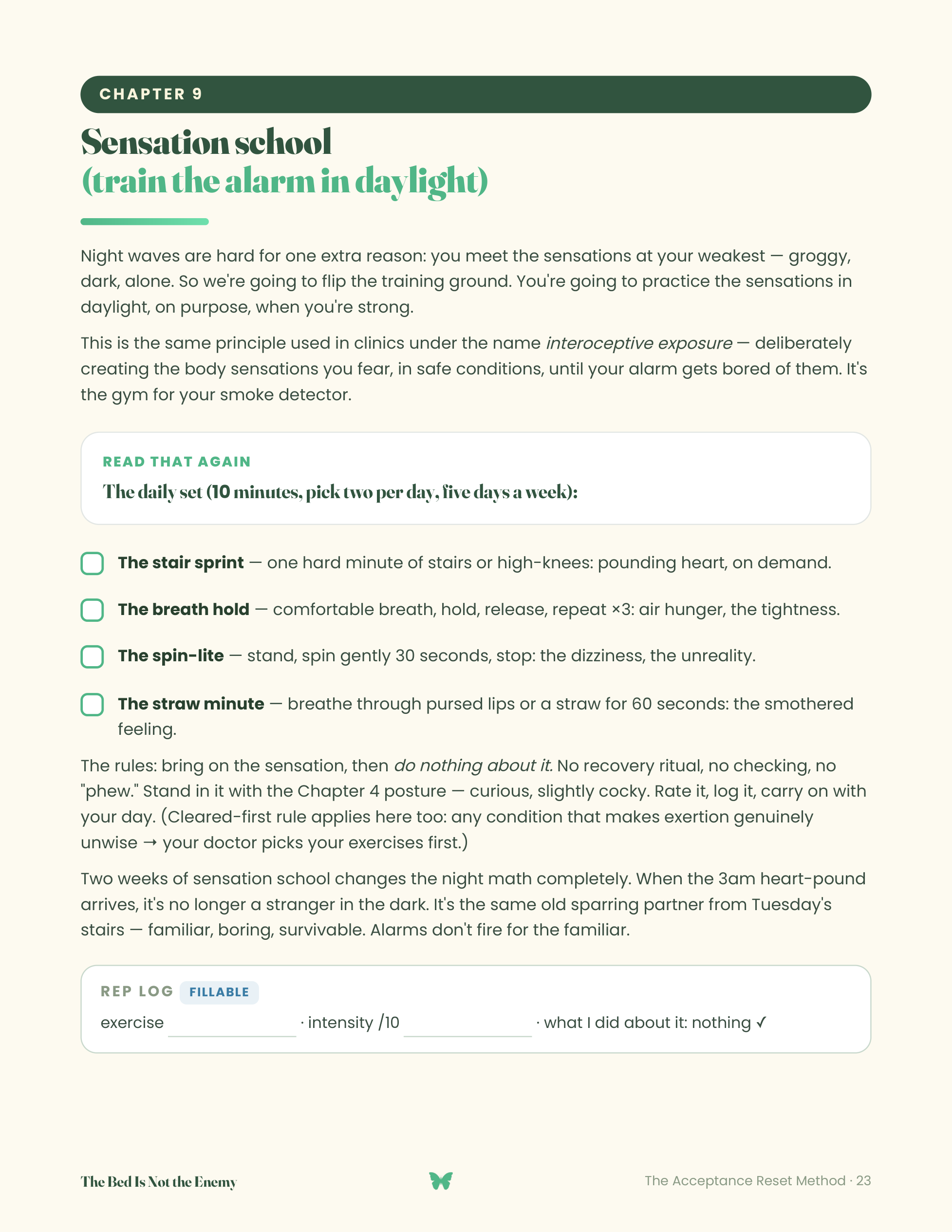
No. What's above is the core reframe and one move, free and genuinely complete. The kit is the full structured system — the 4-step protocol, the bed-retraining week, worry scheduling, sensation training, the worksheets and the 30-night plan — the parts that turn one good night into a fixed pattern.
The complete system — guide, worksheets, cards and audio. Instant download, yours forever.
🛡 30-day unconditional money-back guarantee · instant PDF · free preview pages
Want the whole system? Get all the kits together in The Complete Panic Toolkit — $44.99, or the full Acceptance Reset Method — $47.
A self-guided educational program built from lived experience and published research — not medical or psychological treatment. Results vary from person to person.
New, unusual, or unchecked symptoms — a racing heart, chest pain, anything that feels different from your normal? Get medically cleared first. This begins after a doctor has ruled physical causes out.
This retrains a learned alarm over time — it doesn't promise to cure anxiety or replace care from your own clinician. Any medication decisions stay between you and your doctor.